
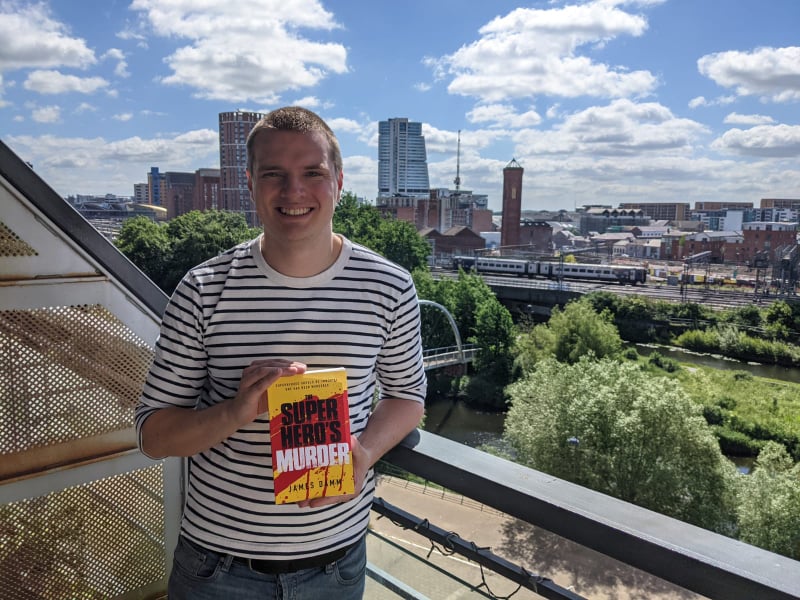
Behind The Book
Why did I write The Superhero’s Murder?
I’ve loved superheroes for as long as I can remember. Batman and Spider-Man were my childhood favourites, and I grew up watching the 1990s X-Men and Spider-Man animated series cartoons.
As I got older, I became fascinated by stories like Watchmen that deconstructed the superhero genre. But even those stories were usually asking American questions. I wanted to explore what a superhero would mean in Britain, where class, politics and public perception would shape their existence very differently. That became the foundation of The Superhero’s Murder.
The question behind the novel
Every novel I write begins with a question.
Would a real superhero actually make the world better?
Most superhero stories ask whether someone can save the world. I became much more interested in whether society would ever allow them to. If one extraordinary person really existed, would they unite us, or would they simply expose the divisions that were already there?
Why is John Fitzgerald never the main character?
One of the biggest early influences on the novel was World War Z. I loved the idea of telling a story through the people left behind rather than through the central figure. From the beginning, I wanted John Fitzgerald to be absent. Readers don’t watch Britain’s only superhero save the world. Instead, they experience the political, personal and emotional vacuum left behind after he’s murdered. The story isn’t about a superhero, it’s about the world that remains without one.
What did I deliberately avoid?
I consciously avoided many familiar superhero conventions. There are no capes, no secret identities and no lengthy origin story explaining where John’s powers came from. Those questions never interested me as much as the consequences of his existence. I also never wanted John to return from the dead or become the narrator. His absence is what gives the novel its perspective.
What themes does the novel explore?
Although it’s built around a superhero, the novel explores identity, class, public image, power and responsibility. Growing up in the North of England, I was interested in asking what would happen if the world’s greatest superhero wasn’t an American icon, but a working-class man from Britain. Would that superhero get accepted as who they are?
Who might enjoy this book?
If you enjoy character-driven thrillers that ask “what if?” rather than simply celebrating superhero spectacle, The Superhero’s Murder may be for you. Readers who enjoy stories like Watchmen or World War Z; stories that look at familiar ideas from an unexpected angle will hopefully find something here.
What I hope readers take away from it
More than anything, I hope readers finish The Superhero’s Murder asking not whether a superhero could save the world, but whether we’d ever let them. While writing the novel, I came to the conclusion that society’s biggest problems can’t be solved by one extraordinary person. Climate change, war and inequality don’t disappear because someone can fly. If we’re to fix the ills of the world it will take more than one person, and unfortunately I don’t think humanity is up to the job.